
Black Hole Relationships
How to Detect and Escape Toxic Bonds That Drain Your Life


“In four ways should one who brings ruin be understood as a foe in the guise of a friend:
he is a companion in indulging in intoxicants that cause infatuation and heedlessness (heedlessness = distraction/inattention)
he is a companion in sauntering in streets at unseemly hours
he is a companion in frequenting theatrical shows
he is a companion in indulging in gambling which causes heedlessness”
- Buddha
“I just like helping people”
That was my motto for most of my life, and it was a lie.
I felt safe helping people.
And “helping” meant focusing on other people’s problems instead of my own.
I sought out people who had more problems than me in an effort to fix them instead of fixing myself.
At the time this felt like a genius move, when in reality it was simply an avoidance tactic.
My motivation to be the ‘helpful problem solver’ was coming from weakness, not strength.
I spent a lot of time trying to help people, I can’t say that I didn’t learn anything.
Sometimes I achieved fantastic, transformative results.
Sometimes I had to rapidly learn new things and it created an environment of mutual growth.
Sometimes (I didn’t realize this until later) I became a prostitute that people used to mentally masturbate their problems and complaints to.
What I failed to notice was that people who flaunt their problems publicly and eagerly accept loads of help are usually a bit suspicious.
My dialogue surrounding these people started to sound like
“Yeah, [name] acts like ____. But they’re a good person.”
“They’re just acting that way because they’re in a bad situation. They’re trying their best”
“Their heart is in the right place”
“I’m helping them/we’re helping each other”
I started to dread the next interaction, text message, or conversation. I felt like I was on call 24/7 in case they needed me.
In my mind I was being morally righteous, playing the hero.
It would be ‘wrong’ not to help and contribute to someone just because they were causing me stress or acting in hurtful ways.
At least that’s what I was selling myself.
Some of these relationships were also supposed to convert into some form of income, since we were trying to push forward in business.
The lack of progress + unpleasant feelings made me examine things more closely.
I noticed a few things
I was pouring around 30 hours per week into other people’s problems and projects
I felt drained and had no attention/energy to work on my own pursuits.
All of the time I spent was working on their problems and projects, but never mine.
I realized that these relationships were one-sided.
My ‘heroic problem solver’ frame didn’t strike me as a strong enough reason for the dynamic to be the way it was.
I contemplated and noted a few more things
They are more than willing to take hours of my time to talk, vent, and use my insights without reciprocating
They turn on me the second I have a problem
They only talk to me when they want something
We’re making little to no progress with what we’re working on
I have to fight and argue to move forward in the direction they say they want to move
It became undeniably clear that these situations were holding me down.
Fortunately, I noticed a convenient way to exit.
If someone
Doesn’t pay attention or care when you respond
Is only interested in talking about themselves and their problems
Misstates things you said, your personal history, or recent life events
Doesn’t remember information that you mentioned within the last 20 minutes
It’s a good signal that they’re using you as a talking post. (I’ve had people more or less directly say that they’re doing that, actually)
To test this, I adjusted my communication and started to pay closer attention.
I started to talk about 90% less during conversations and…nothing about the communication changed.
There were times that I muted my microphone and left my phone unattended for over 30 minutes and when I came back they were still talking.
Another thing I started to do is, instead of repeating myself, I would say something once and watch closely to see if they responded to it.
They would continue to speak like I hadn’t said anything.
It dawned on me that I essentially didn’t exist in these interactions.
I became aware that we had differing interests and intentions.
I wanted to grow, build, and move forward. But I was afraid to do it myself and wanted someone I could ‘fix to success’.
They wanted someone to validate their problems, and someone who would quietly and peacefully allow them to complain for hours on end.
Intentions in both cases were unstated and probably unconscious, but that doesn’t change the fact that the situation wasn’t conducive. At least not for anything that I wanted in my life.
Once it became clear that those relationships were nothing but black holes in my life sucking in my time, energy, and effort, I spent the next couple of months disentangling myself from them.
Unsurprisingly, about 80% of the stress and tension in my life dropped off, and I learned by contrast to detect the people I should be working with and sharing my time with.
There is a risky misinterpretation that can arise with the self-improvement mindset, which is that you’re meant to push against these dysfunctional situations and make them work.
This will make you stronger.
Increase your stress tolerance.
improve your ability to communicate under pressure.
trigger you to refine your speech.
However, this is not going to reverse the situation.
All dysfunctional situations can make you stronger, but that doesn’t mean they’re working. It means you’re making them work.
To build the life you want, it’s essential to have relationships that synergize with your goals and intentions, give you more energy, and make you feel more free.
I’m going talk about
Why black hole relationships start
Why we feel obligated to stay
How to identify them
How to leave
How to start forming synergistic relationships
“Intelligent people tend to have less friends than the average person. The smarter you are the more selective you become”
Nikola Tesla
The Victim-Vice Cycle
The foundation of a Black Hole Relationship is the victim-vice cycle. We can all relate because at some point we’ve all played the victim.
Maybe you are right now in some areas of your life or maybe you know someone who is.
Why?
Why We Play The Victim (Benefits & Costs)
The power of the victim mindset comes mainly from 2 things
it releases you from the pressure that comes from taking responsibility in your life
It frees you from the struggles of growth and change.
The cornerstone of the victim mindset is an unsolvable problem.
To create an unsolvable problem, you choose any problem and target its association to an external entity.
Then claim with conviction that those external factors prevent any possible solution. Now, since you can’t change them, you’re in the clear.
Whether someone does that consciously or unconsciously, the stress of directing one’s life is exchanged for short term pleasures.
And if you endlessly indulge in short-term pleasures, how can the long term consequences ever hit!
You can just manage the overwhelm caused by the unsolvable problem with short-term pleasures. Things like food, drugs, or alcohol.
But there’s a cost.
The Price Paid to be a Victim (the cycle)
It consumes a huge amount of energy. Causing fatigue, irritability, and the inability to focus.
Lack of energy and focus leads to the inability to pursue goals and build a meaningful life.
The inability to create a meaningful life keeps us stuck in negative emotional states(anger, depression, anxiety)
The pain and drain of negative emotional states leads to addictions and use of vices (alcohol, drugs, food, sex, gambling, even something like arguing)
The use of vices + stress causes a decline in health.
This decline in health creates a sharper energy drain
And it becomes a vicious cycle.
Hedonistic Support Groups
Once a group of people comes together to justify and commune around the victim-vice cycle, it effectively creates the ‘black hole’ effect that I’m talking about.
It doesn’t matter if it’s 1 other person or 100 other people. As soon as you have social support, a punishment exists for dropping the problem or dropping the vice.
If you look at some of the dynamics I’m going to talk about soon, you’ll know the exact type of relationships/groups I’m talking about. If you haven’t recognized it already. We’ve all experienced it.
These dynamics are especially alluring and dangerous for someone in the ‘helpful problem solver’ frame, because you wind up helping people who do not actually want help. (It’s easy to do that, it’s just doing nothing and listening to people talk, then having them ignore your response)
If someone is complaining it is rarely a request for help. It’s usually a request for someone to allow them to have their mindset and emotional state uncontested.
There is a natural temptation to ‘accept and give space’ to these people. Or even expect it from others if you’re the one executing the behavior. Creating the perfect situation for you to stay because it’s “Not so bad”.
There are ways to present opportunities for someone who’s stuck like that, but actually helping people is generally not so challenging.
They do most of the work, consume supplemental material to clarify that they understand what you’re saying, and come back to you with updates about what you suggested.
Ending Black Hole Relationships
“When someone comes to you with a problem, do you magnify it and make them more miserable? Or do you make them feel lighter and more confident so that they walk away with a smile?“
Gurudev Sri Sri Ravi Shankar
At their foundation, relationships are either functional or dysfunctional.
Although relationships are complicated and have unique nuances, we generally break them into a few categories.
Romance
Friendship
Partnership
Caretaker/Authority Dynamics.
We identify them as their primary type, but all relationships have some mixture of every type.
To get an idea of what exactly goes wrong with a Black Hole Relationship, let’s look at a normal, functional relationship.
Then, I’ll talk about how to shift your mindset, communication, and actions to leave dysfunctional relationships.
I’ll use a romantic relationship as an example.
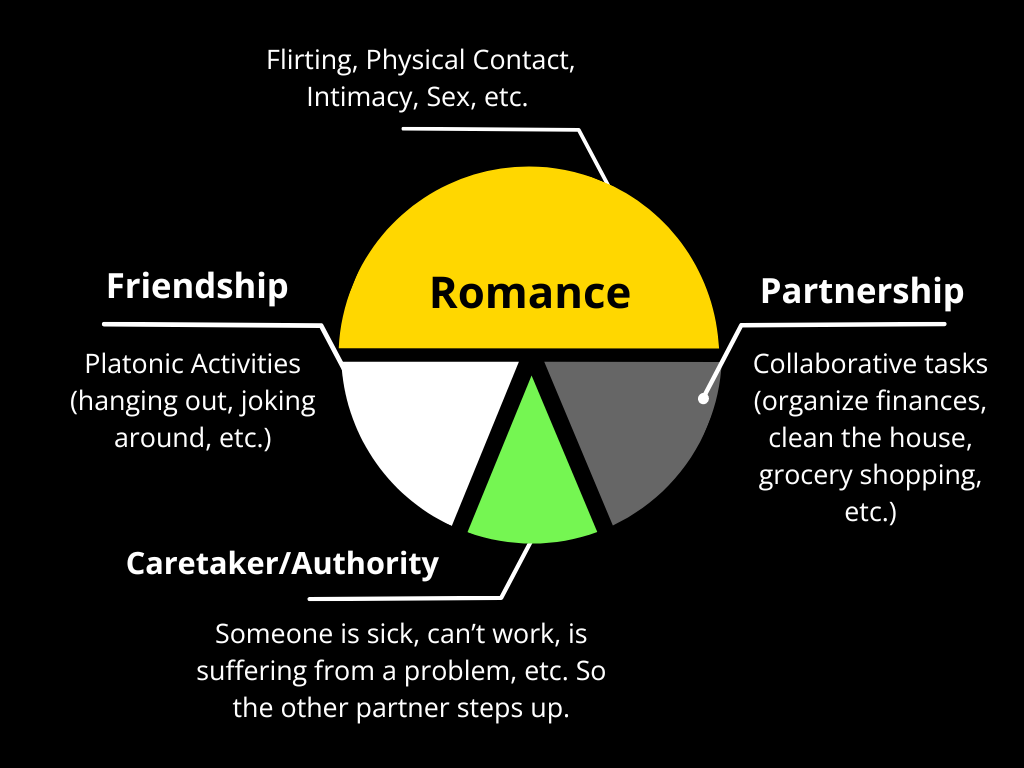
‘The Black Hole’ is a distortion of a functional relationship dynamic.
It looks more like this
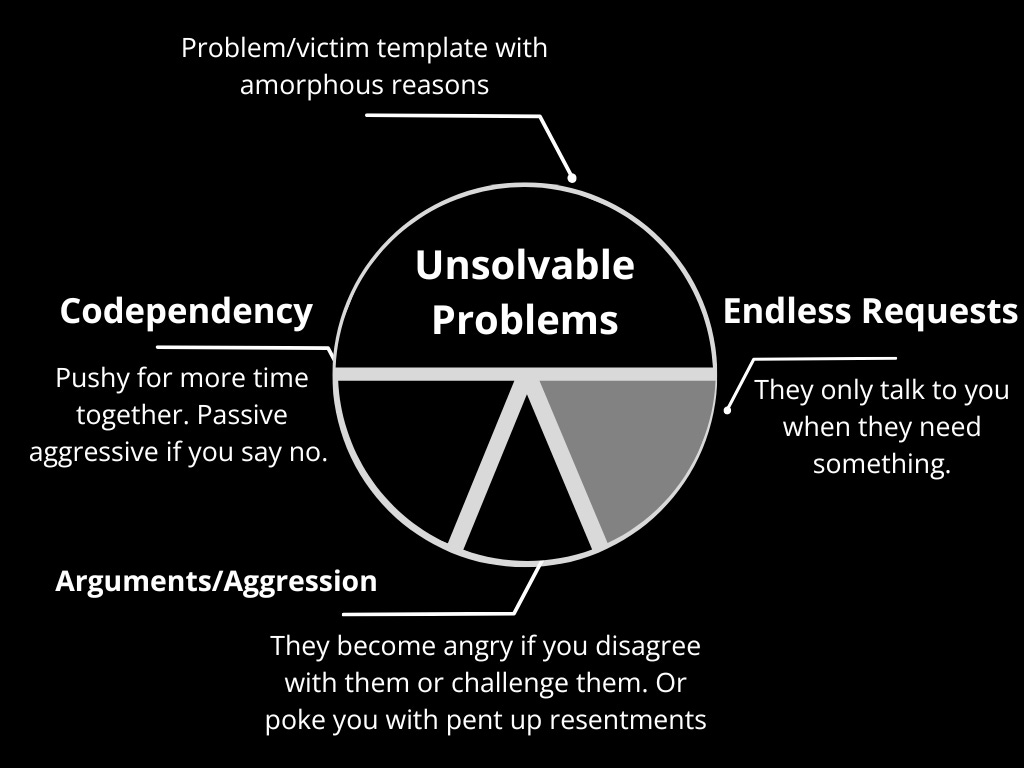
All of the things that a functional relationship has are replaced by traditionally toxic behaviors, which are underpinned by the use of vices and other forms of escapism.
Now what exactly do you do to get out of it?
Mindset Shift
“Here’s how you can tell someone is your friend: A) You can tell them bad news, and they’ll listen. B) You can tell them good news, and they’ll help you celebrate”
Jordan B Peterson
We have been trained to disregard or dismiss the negative effects of dysfunctional relationships. Or even think that it is wrong to acknowledge (even internally) that a relationship is unhealthy or ineffective.
We might feel guilty, like it’s morally wrong or that we’re abandoning someone for putting ourselves first.
The first step toward breaking out of this mindset is to flip the frame. The easiest way to do that is to be transparent about what we’re losing when we maintain unhealthy relationships.
There are massive downsides to dysfunctional relationships. I would list them but the entire article so far, and what comes after this is basically a list of the downsides.
How your life develops physically, mentally, emotionally, socially, and financially, is heavily linked to who you spend your time engaging with.
The classic self-improvement aphorisms are true.
“Your network is your net worth” - Tim Sanders
“You’re the average of the five people you spend the most time with” - Jim Rohn
What we want are relationships that;
strengthen our body
focus our mind
make us feel emotionally fulfilled
and as a consequence boost our;
productivity
ability to build things
ability to create healthy connections.
Just because you’ve known someone for a long time doesn’t mean that they can’t be an asshole.
Everybody is always leading even if they aren’t conscious of it. it’s not a statement against people to realize that they’re leading you in the wrong direction. What you’re seeing is their best behavior, they don’t have some hidden secret potential.
Actions, especially repeated actions, reveal someone’s true nature and intention.
Someone’s repeated actions are incomparably more significant than their words.
We want to be okay with, even intend to ward away people who are unsavory and conflict with our goals. Disregarding(politely) anyone who doesn’t synergistically listen to you and communicate with you.
Find like minded people who appreciate you and add energy to what you do, creating a synergistic effect when you interact with other people.
If you jump into situations with the intention playing the hero and converting everyone who disagrees with you instead of giving value to those who make your life easier, you’ll lose every time.
Your Biggest Advantage
People who are upholding Black Hole Relationship standards tend to be rather fickle. They also misclassify you and don’t listen to you.
This is advantageous because really, aside from your agreement and unhealthy emotional attachments, there is nothing tying you down.
The following section will reveal a series of subtle shifts that you can make with your attention to clarify if it’s time to start questioning your relationships, and some things you can do if it is.
Here’s a checklist of common things in Black Hole Relationships that you can notice.
BHR Checklist
How you feel
Dreading the next call or text
Worrying that they are going to misinterpret or misuse what you said
Feeling on call 24/7
What you’re saying(justifications)
Their heart is in the right place
They’re trying their best
They don’t have bad intentions
Yeah, they’re acting like [a bad person]. But that’s just who they are. They’re really a good person.
They’re just in a bad situation
Real friends stick it out together
I’m helping them/we’re helping each other
Family should always come first, no matter what
What You’re doing
Sinking hours every week into their problems and feeling too drained afterwards to focus on things that you should be doing.
Playing the hero
Indulging in vices, so you still have an “in” to “help”
Your main conversation topic with other people is about how this other person/other people can’t solve their problems
What They’re doing
Problem dumping unsolvable problems
Demanding time and favors
Passive-aggressively poke or target you with insults if you challenge the unsolvable problem too directly. Or if they’ve just built up resentment.
Whenever a solution is presented that is reasonable and viable, they change the cause of the problem
Their interests, hobbies, tasks, etc., are always the priority.
They only speak to you when they want something
They turn on you the second you have a problem
They are more than willing to take hours of your time to talk and vent, but dismiss your opinion and input afterwards
Communication Shift
The purpose of shifting your style of communication is to get you to reveal what’s going on in front of you that’s surprisingly easy to miss. If nothing is going on, these shifts in communication won’t cause any problems.
Say less
What I’ve noticed in black hole relationships is that it’s easy to convince yourself that you’re contributing to a situation in a way that you are not. When silence feels natural, and you’re never called on to do anything besides agree, there’s a strong chance that you’re not really being valued for anything about you. Just the fact that you’re being passive.
If they’re engaging with you in the discussion it will be obvious, and be difficult not to talk in a meaningful, enjoyable way.
Ask Questions Using Their Information
Watch out for storybending. It’s very easy to get thrown by the whirlwind of changing information that people throw out when just trying to be right and feel justified.
The natural reaction to someone dumping a bunch of information on you is to
fall in line with their emotional state
believe them
agree with them
give them your opinion/a bunch of information
Before you believe the story and scenario they are presenting, simply ask them questions about it.
When did that happen?
Do you think it will happen again?
What would you like to happen instead?
Do you think there’s anything you could do about it?
Anything else you could come up with. Your goal is to qualify whether or not what they said was true or if there was crucial context missing.
Watch for
Changing/contradictory information
Omitting information
They know what they need to do, but decided it’s not possible
Mischaracterizing the situation
Hiding the fact that they’re the one causing the problem.
Don’t Repeat Yourself
It’s easy to fall into the pattern of repeating something you want a response to a few times, then having your statement challenged, and then after you defend it you may get a response.
By not repeating yourself, you stop fighting to be heard and reveal what dynamics are really at play.
It is normal to repeat yourself in conversations, people miss things and need information to be clarified.
You’ll be able to tell if there’s an unnatural amount of your speech going ignored.
Creating Synergistic Relationships
“If you don’t have many friends, that means you have a lot of life experience!”
Albert Einstein
During the time I referenced at the beginning of this article, I was framing my participation in repetitive cycles of toxic behavior as something that boosted my status and made me a ‘good person’ because I was ‘helping people’.
More than that, I was unconsciously executing a behavioral pattern that I believed would get my needs met and get me where I wanted to go in life.
But that’s not how it works.
Pick YOUR Side
While I was stuck pandering out of a sense of insecurity, I never stopped to think about what people would actually be helpful to have around.
This required me to think about my goals, commit to something specific, and go through some trial and error.
At the end of the day it’s not only fair to put yourself first, but necessary if you ever want to contribute meaningfully to those around you.
You can’t give from an empty basket, that strategy doesn’t work.
Baseline Standards
It’s not immediately clear if you aren’t used to having them, but standards are a no-brainer.
Essentially, if you compiled a list of traits and qualities you don’t want around you, and then a list of traits and qualities that you do want around you, would you want to be around a person who has the first list?
Obviously not. Would you want to be around someone who has the second?
Obviously.
And if you have people in your life who happen to have most of the things on the first list, will you really have to think about changing things?
That’s all your standards are, just instituted in your life as a filtering mechanism.
Depending on your goals you’ll develop a unique set of them, but there are a few that serve as a good foundation.
Remember, someone’s repeated actions are unspeakably more telling than their words. So you should filter people by their repeated actions.
“Wishing to be friends is quick work, but friendship is a slow ripening fruit.”
Aristotle
Basic Standards
Someone who takes consistent actions to achieve their goals
Someone consistently takes action to maintain/improve health
Someone who frequently communicates in a self-reflective way
Someone who regularly seeks growth in their relationships
Conclusion
Relationships can be complicated, but it’s for that exact reason that the last thing we should do is ignore them.
Everyone has the same 24 hours in a day, and in that 24 hours some people achieve great things and some people do literally nothing.
It’s incredibly challenging if not impossible to achieve great things if chunks of your 24 hours are being poured into the wrong people.
Amazing read 👏🏼